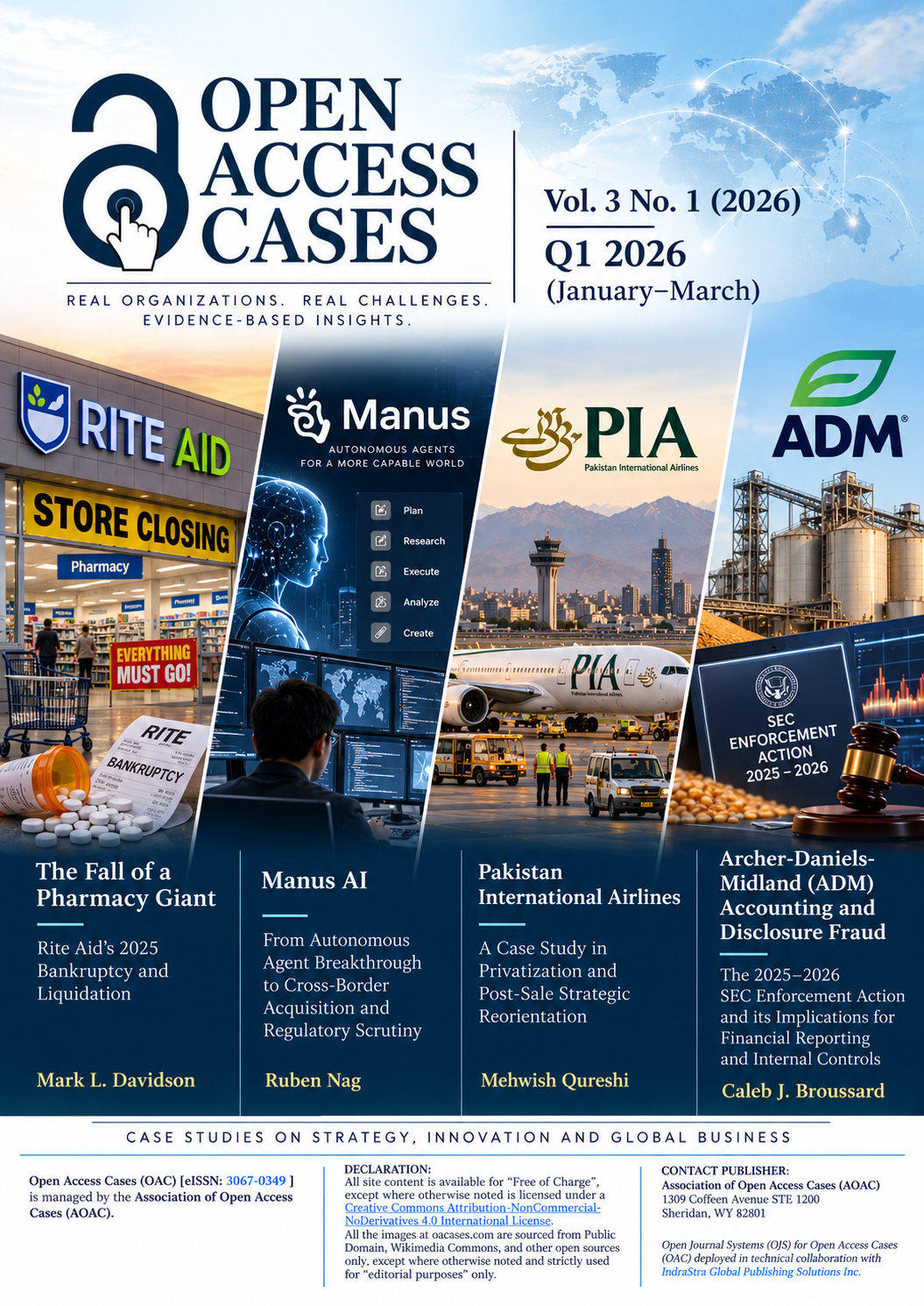
Archer-Daniels-Midland (ADM) Accounting and Disclosure Fraud
The 2025–2026 SEC Enforcement Action and its Implications for Financial Reporting and Internal Controls
DOI:
https://doi.org/10.5281/Keywords:
ASC 280 Segment Reporting, SOX Section 404 Compliance, Accounting Disclosure Fraud, Regulatory Compliance, Earnings Management, Internal Controls (SOX 404)Abstract
Archer-Daniels-Midland (ADM), a global leader in agricultural origination and processing, found itself embroiled in a significant accounting and disclosure fraud investigation between 2025 and 2026. This case study delves into the intricacies of the alleged fraud, which centered on the manipulation of inter-segment transactions within ADM’s Nutrition division from 2019 to 2022. The investigation, culminating in a substantial settlement with the U.S. Securities and Exchange Commission (SEC) in January 2026, exposed critical deficiencies in ADM’s financial reporting, internal controls, and corporate governance. This case serves as a compelling illustration for graduate-level students in accounting, finance, and corporate governance, highlighting the profound implications of earnings management, segment reporting manipulation, and the subsequent regulatory enforcement actions.
The core of the alleged misconduct involved the strategic inflation of operating profits within the Nutrition segment through improper inter-segment transactions. This practice, reportedly driven by pressure to meet ambitious growth targets, led to a misrepresentation of the segment’s financial performance. The SEC’s investigation brought to light violations of fundamental accounting principles, particularly those related to segment reporting under ASC 280, which mandates that inter-segment pricing approximate market terms. The ensuing restatement of financial statements, coupled with the disclosure of material weaknesses in internal controls, triggered a significant decline in ADM’s stock price and raised serious questions about the oversight responsibilities of its executive leadership and audit committee.
This case study will meticulously examine the mechanisms employed to shift profits, the specific accounting and regulatory violations, the breakdown of internal controls under SOX Section 404, and the comprehensive SEC enforcement action. Furthermore, it will analyze the market’s reaction to these revelations, the subsequent remediation efforts undertaken by ADM, and the broader lessons for corporate compliance and ethical leadership. By dissecting the ADM fraud, students will gain invaluable insights into the complexities of financial reporting in multinational conglomerates, the pressures that can lead to earnings management, and the critical role of robust internal controls and effective governance in safeguarding financial integrity and investor trust.
Downloads
Published
Issue
Section
License
Copyright (c) 2026 Open Access Cases

This work is licensed under a Creative Commons Attribution-NonCommercial-NoDerivatives 4.0 International License.
The CC Attribution-NonCommercial-NoDerivatives 4.0 (CC BY-NC-ND 4.0) license allows users to:
- Attribution – Use the material, provided proper credit is given to the original creator, in accordance with the citation requirements specified by the author.
- NonCommercial – Use the material only for non-commercial purposes, meaning it cannot be used for commercial gain or in any way that supports a commercial endeavor.
- No Derivatives – Use the material only as-is, without modifying, remixing, or building upon it. The work must not be transformed in any way.
This license does not allow for adaptations or derivative works, and it restricts the use of the content for commercial purposes. The material must be attributed to the original creator, and any usage must align with the specified terms.