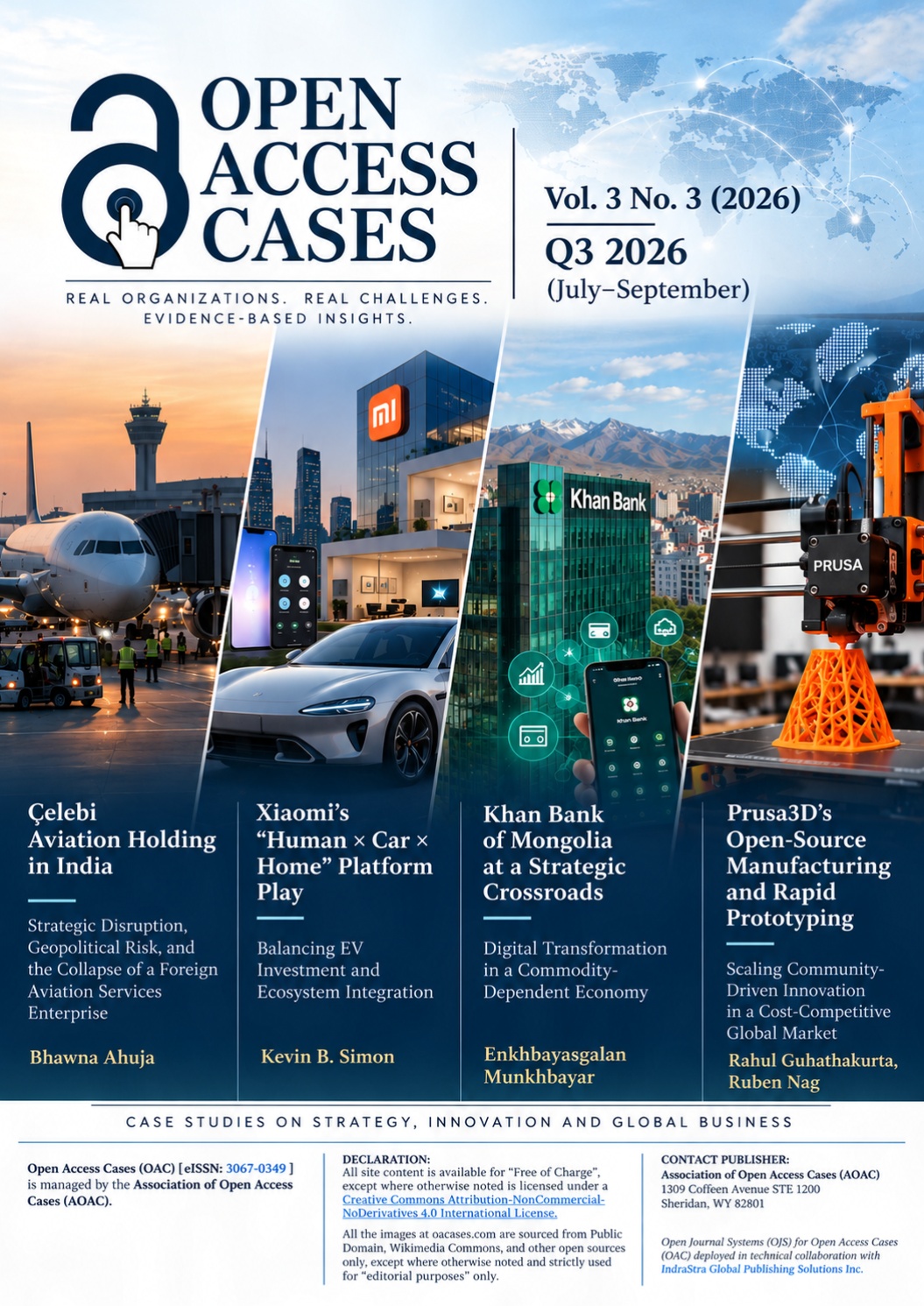
Prusa3D's Open-Source Manufacturing and Rapid Prototyping
Scaling Community-Driven Innovation in a Cost-Competitive Global Market
DOI:
https://doi.org/10.5281/zenodo.23430337Keywords:
open-source hardware, 3D printing, supply-chain resilienceAbstract
Prusa Research, the Prague-based maker of Original Prusa 3D printers, grew from the open-source RepRap movement into a group of specialised companies whose five main operating entities reported combined revenue of about CZK 6.6 billion in 2024 before intra-group eliminations. By 2026 lower-priced enclosed printers were widely available, and four vendors shipped 88 per cent of entry-level units. This decision case asks how an open-source hardware firm can convert community-driven innovation into durable advantage while scaling manufacturing, protecting quality and sustaining supply continuity. Using audited registry filings, company publications, GitHub records and dated price evidence available by 15 August 2026, the case introduces the qualification bottleneck: the scarce capability to test and validate parts, suppliers and code, which may both deter imitation and limit supplier substitution. An illustrative model applies contribution margin, break-even volume, landed cost, buyer total cost of ownership, break-even disruption frequencies and sensitivity analysis. Seven strategic options are evaluated under three weightings without a preferred answer. The case suits courses in operations, supply chain and technology strategy.
Downloads
Published
Data Availability Statement
The data cut-off for this case is 15 August 2026; only information publicly available on or before that date was used to establish facts. Financial data are from audited statutory filings of Prusa group companies in the Public Register of the Czech Ministry of Justice. Community data were retrieved from public GitHub repositories, and undated web pages are cited through Internet Archive captures made on or before the cut-off. All sources are listed in the references. Values in the quantitative model are teaching-case assumptions, not company data; the model inputs and outputs are reported in the exhibits.Issue
Section
Categories
License
Copyright (c) 2026 Open Access Cases

This work is licensed under a Creative Commons Attribution-NonCommercial-NoDerivatives 4.0 International License.
The CC Attribution-NonCommercial-NoDerivatives 4.0 (CC BY-NC-ND 4.0) license allows users to:
- Attribution – Use the material, provided proper credit is given to the original creator, in accordance with the citation requirements specified by the author.
- NonCommercial – Use the material only for non-commercial purposes, meaning it cannot be used for commercial gain or in any way that supports a commercial endeavor.
- No Derivatives – Use the material only as-is, without modifying, remixing, or building upon it. The work must not be transformed in any way.
This license does not allow for adaptations or derivative works, and it restricts the use of the content for commercial purposes. The material must be attributed to the original creator, and any usage must align with the specified terms.