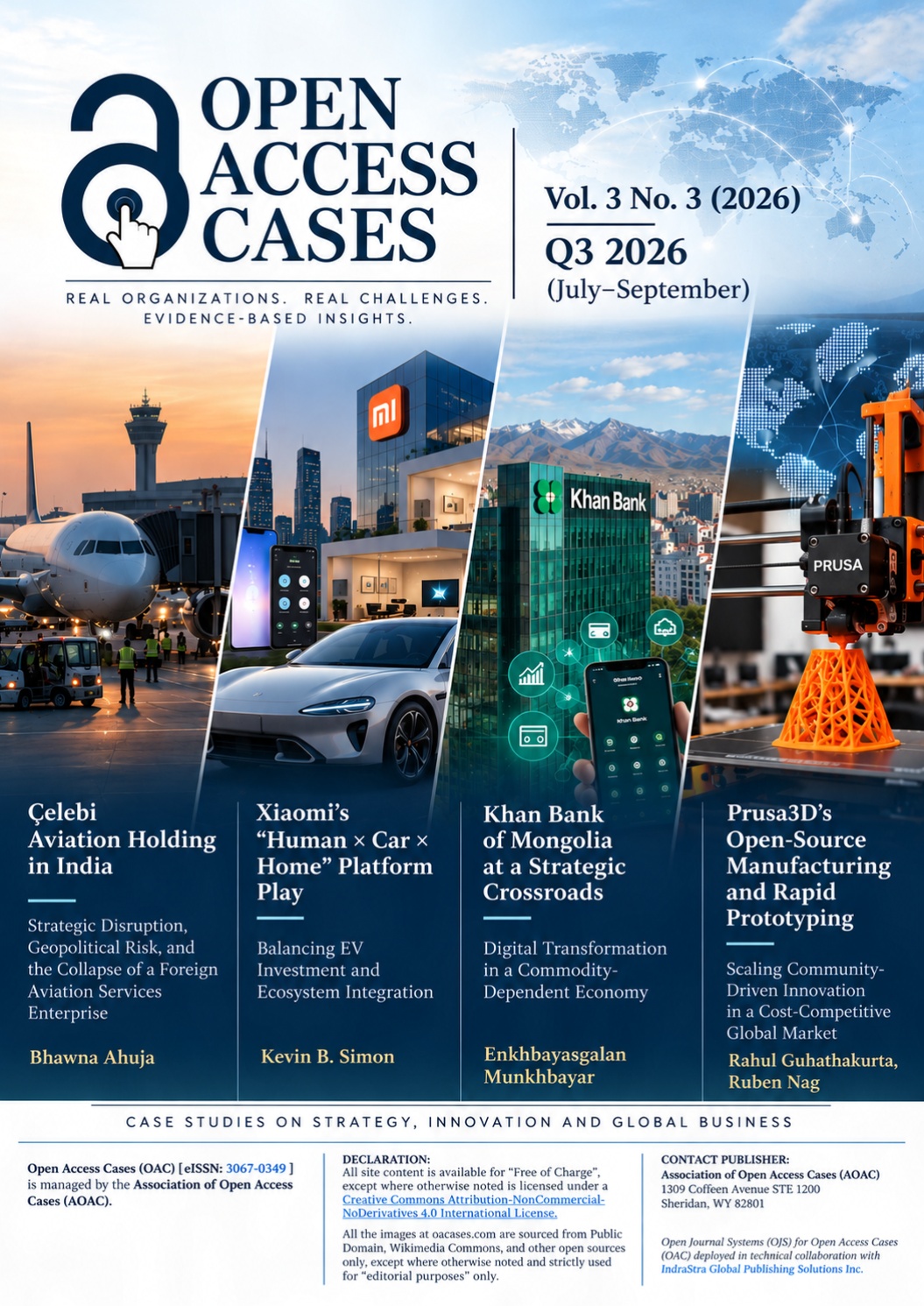
Khan Bank of Mongolia at a Strategic Crossroads
Digital Transformation in a Commodity-Dependent Economy
DOI:
https://doi.org/10.5281/zenodo.23430278Keywords:
Khan Bank, Mongolia, Digital Banking, Financial Inclusion, Capital AdequacyAbstract
Khan Bank JSC, which held about 30% of Mongolia's banking assets in mid-2026, built its franchise on a branch network that reached provinces, soum centres and border points across a vast, sparsely populated country. By mid-2026 it held about a third of system loans, 99.6% of its transactions were digital, and online loans made up 31% of its portfolio. Growth came at a cost: from 2023 to June 2026 the bank's capital adequacy ratio fell from 18.6% to 14.7%, against a Tier 1 threshold it reports as 13%, while inflation reached 13% and the central bank raised its policy rate to 12.5% in August 2026. This decision case, written with data available to 15 August 2026, asks how the board should allocate incremental investment and capital among three options: national digital scale, rural assisted-digital and MSME inclusion, or capital and resilience first. Using audited statements, stock-exchange filings and multilateral sources, it examines digital fee economics, credit and capital sensitivities, governance after the 2023 IPO and gaps in disclosed management information. It proposes a capital-clock lens for discussion and leaves the decision open.
Downloads
Published
Data Availability Statement
All data used in this case are drawn from publicly available sources cited in the references, including Khan Bank's audited financial statements, annual, sustainability and operational reports filed with the Mongolian Stock Exchange, results notices published by HS Holdings Co., Ltd. through the Tokyo Stock Exchange, Bank of Mongolia publications, and IMF, World Bank and Asian Development Bank reports. The data cut-off is 15 August 2026; no information published after that date is used. No proprietary or confidential data, interviews or company access were used. Sensitivity tables are the author's calculations from the cited figures, and their assumptions are stated in the exhibit notes.Issue
Section
Categories
License
Copyright (c) 2026 Open Access Cases

This work is licensed under a Creative Commons Attribution-NonCommercial-NoDerivatives 4.0 International License.
The CC Attribution-NonCommercial-NoDerivatives 4.0 (CC BY-NC-ND 4.0) license allows users to:
- Attribution – Use the material, provided proper credit is given to the original creator, in accordance with the citation requirements specified by the author.
- NonCommercial – Use the material only for non-commercial purposes, meaning it cannot be used for commercial gain or in any way that supports a commercial endeavor.
- No Derivatives – Use the material only as-is, without modifying, remixing, or building upon it. The work must not be transformed in any way.
This license does not allow for adaptations or derivative works, and it restricts the use of the content for commercial purposes. The material must be attributed to the original creator, and any usage must align with the specified terms.