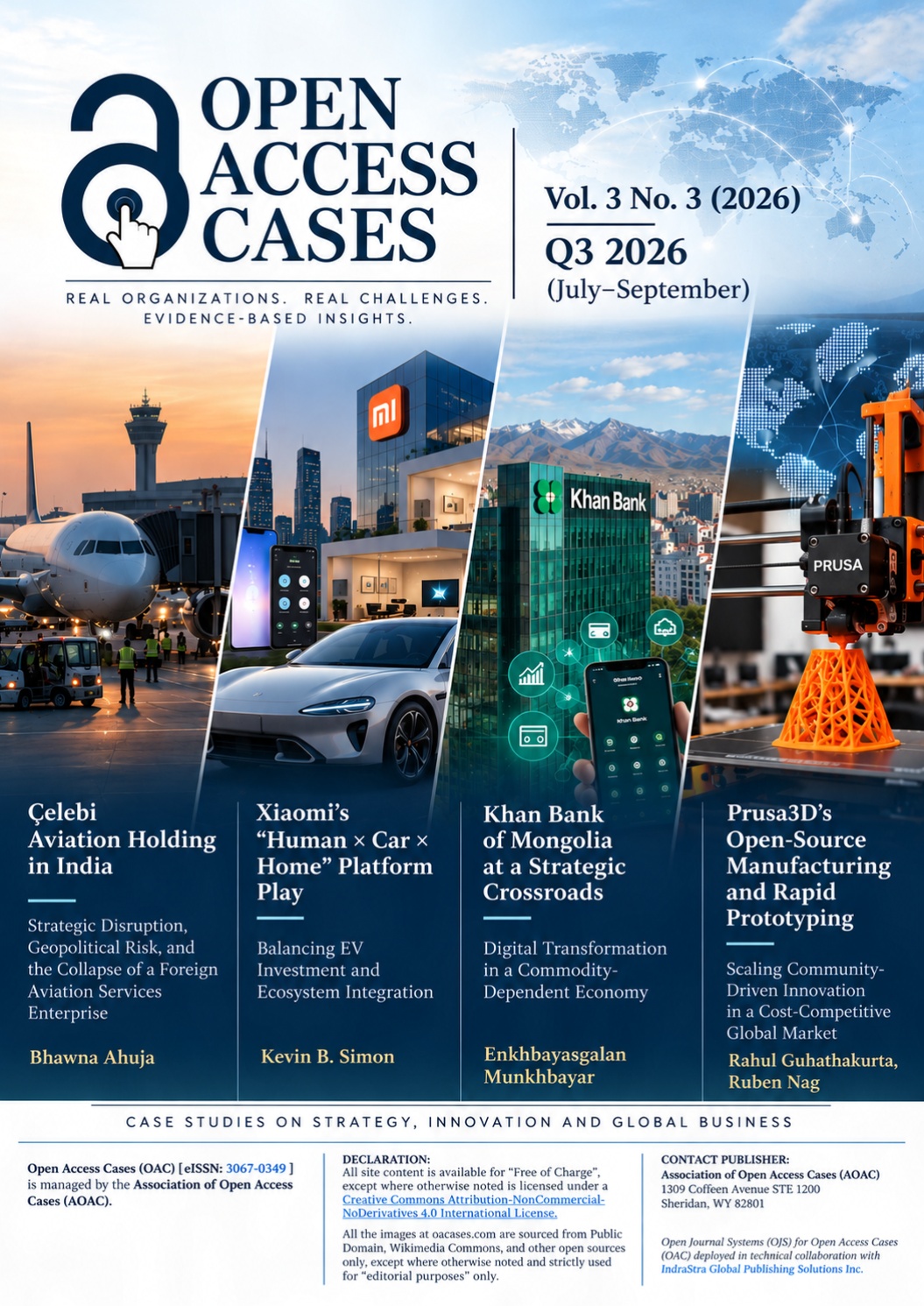
Xiaomi’s “Human × Car × Home” Platform Play
Balancing EV Investment and Ecosystem Integration
DOI:
https://doi.org/10.5281/zenodo.23430187Keywords:
Xiaomi, Electric Vehicles, Platform strategy, Capital allocation, Brand extensionAbstract
In September 2025 a software recall of 116,887 Xiaomi SU7 sedans was fixed by an over-the-air update that also delivered new ecosystem features, showing how closely Xiaomi had tied its car to the operating system and brand of its smartphone and smart-home business. This case is set on 15 August 2026. Xiaomi’s car segment had reported its first full year of operating income in 2025, then a RMB3.1 billion quarterly loss in early 2026, while deliveries ran at 39% of the year’s target and new models launched at lower prices. Using company filings, regulatory notices, delivery data and press reports, the case reconstructs the unit economics of the segment, estimates break-even volumes and tests three hypothetical scenarios. It introduces a proposed framework, the Ecosystem Coupling Ledger, which treats the tie between car and ecosystem as a choice with both a dividend and a liability, separate from the amount of capital committed. Students assess four alternatives, from integrated expansion to an ecosystem-first posture, on common criteria. The case suits courses in corporate strategy, platform strategy and capital allocation.
Downloads
Published
Data Availability Statement
All data used in this case are drawn from publicly available sources listed in the References, including Hong Kong Exchanges and Clearing Limited filings, U.S. Securities and Exchange Commission filings, Chinese government and regulatory notices, and press reports. The information cut-off is 15 August 2026; later information, including Xiaomi’s results for the six months ended 30 June 2026, is excluded. Calculated and hypothetical values are labelled in the exhibits, and the model used for the unit-economics, scenario and sensitivity exhibits is available from the author on request. No proprietary, confidential or interview data were used.Issue
Section
Categories
License
Copyright (c) 2026 Open Access Cases

This work is licensed under a Creative Commons Attribution-NonCommercial-NoDerivatives 4.0 International License.
The CC Attribution-NonCommercial-NoDerivatives 4.0 (CC BY-NC-ND 4.0) license allows users to:
- Attribution – Use the material, provided proper credit is given to the original creator, in accordance with the citation requirements specified by the author.
- NonCommercial – Use the material only for non-commercial purposes, meaning it cannot be used for commercial gain or in any way that supports a commercial endeavor.
- No Derivatives – Use the material only as-is, without modifying, remixing, or building upon it. The work must not be transformed in any way.
This license does not allow for adaptations or derivative works, and it restricts the use of the content for commercial purposes. The material must be attributed to the original creator, and any usage must align with the specified terms.